
 ultimate-guide
Bespoke Funeral Service Planning Guide: A 2026 How-To
Table of Contents
- What You'll Need Before You Start Planning
- Step 1: Choose the Right Funeral Celebrant Services
- Step 2: Build the Non-Religious Funeral Ceremony Structure
- Step 3: Gather Personalised Funeral Tribute Ideas
- Step 4: How to Write a Funeral Eulogy That Sounds Like Them
- Step 5: Confirm Venue, Timings and Paperwork for a Bespoke Funeral Service
- Common Mistakes to Avoid in Bespoke Funeral Planning
- Frequently Asked Questions
Last Updated: September 29, 2026
What You'll Need Before You Start Planning
Planning a bespoke funeral service begins with gathering information, not making decisions. Before you choose a celebrant or write a single word of tribute, collect the practical details that will shape everything else. This guide walks you through that groundwork so the creative work later feels calm rather than chaotic.
Start with these essentials:
- The death certificate or Medical Certificate of Cause of Death, issued by the attending doctor or coroner, as this unlocks registration and cremation paperwork
- A note of any written wishes your loved one left, including prepaid funeral plans or expressions of preference
- Names and contact details for family members who need to be consulted before decisions are finalised
- A rough budget range, agreed with whoever is contributing, so venue and transport choices stay realistic
- Key life details: birth date, places lived, jobs held, hobbies, significant relationships, and any military or organisational affiliations
A common mistake is starting with the venue. Venues drive timings, and timings drive everything else, so confirm the date and location first. The GOV.UK guide to registering a death sets out the legal steps and who can register, which is worth reading before you commit to a service date.
Step 1: Choose the Right Funeral Celebrant Services
The right celebrant is the one who asks about the person before asking about the date. Good funeral celebrant services begin with listening, and a celebrant who takes an hour to understand your loved one will write a service that sounds like them rather than a template.
When you speak to a celebrant, ask directly:
- What qualification do you hold, and are you insured?
- How many services have you conducted, and in what settings?
- How do you gather the life story, and how long does that take?
- Will you meet the family in person or by video call?
- What happens if you are unwell on the day?
Mary Hopes holds the Level 3 Diploma in Funeral Celebrancy (QCF), the highest national qualification for the sector, and brings over 30 years of public service experience, including time as a Coroner's Officer.
What most guides miss is that a celebrant's job includes the rehearsal of tone. A service for a quiet gardener should not feel like a corporate awards evening. Ask to hear a short sample of how they open a ceremony, not just testimonials.
Step 2: Build the Non-Religious Funeral Ceremony Structure
A non-religious funeral ceremony structure follows a simple arc: welcome, remembrance, reflection, and farewell. Within that arc you can place music, readings, tributes, and silence in whatever order serves the person being remembered.
A workable structure looks like this:
- Welcome and introduction by the celebrant, naming who has gathered and why
- Music or a reading to settle the room
- The eulogy or life tribute, the emotional centre of the service
- Family tributes or readings, if the family wishes to speak
- A period of reflection or silence, often with a chosen piece of music
- The committal or farewell words, at the crematorium or graveside
- Closing words and thanks, with details of any gathering afterwards
The Cremation Society guidance on funeral ceremonies notes that families are free to shape the ceremony as they wish, provided the venue's practical requirements are met. Confirm those requirements early.
Step 3: Gather Personalised Funeral Tribute Ideas
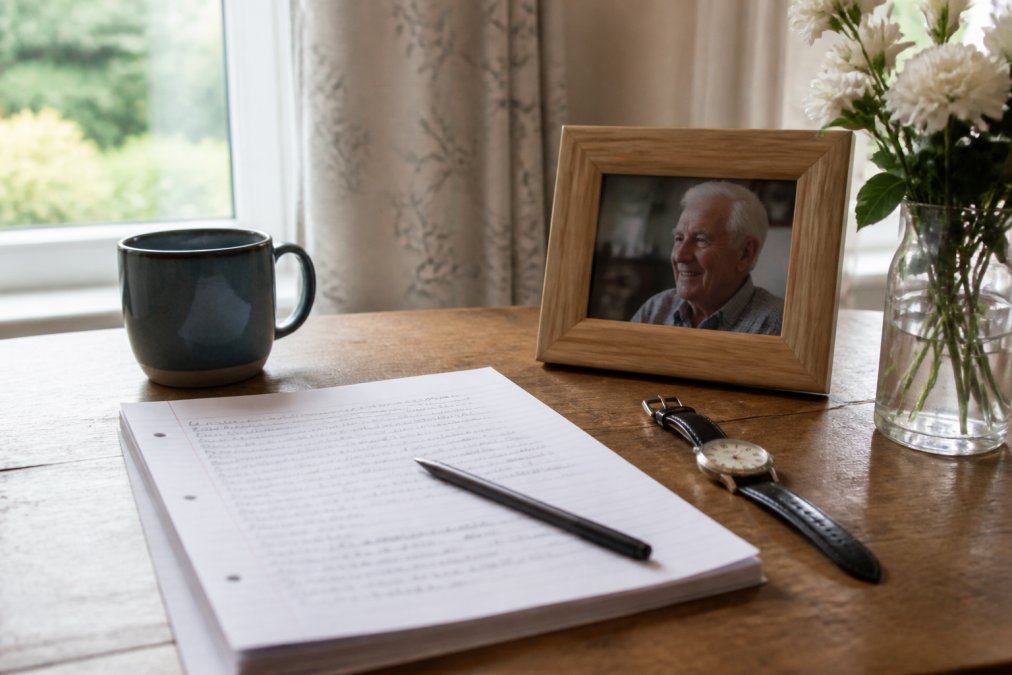
Personalised funeral tribute ideas come from ordinary details, not grand gestures. The mug they used every morning, the route they walked the dog, the song they played too loudly in the car. Specifics carry more weight than adjectives.
Try these prompts with family members:
- What did they always say when they answered the phone?
- What was their signature meal, and who taught them to make it?
- Where did they go when they needed to think?
- What made them laugh until they couldn't breathe?
- What did they worry about, and how did they hide it?
Gather more material than you need. A celebrant can shape memories into a coherent tribute; they cannot invent one. Send photos, voice notes, and rough notes rather than polished paragraphs, because raw material is easier to work with.
Step 4: How to Write a Funeral Eulogy That Sounds Like Them
Learning how to write a funeral eulogy is less about writing well and more about listening well. A eulogy that sounds like the person uses their vocabulary, their rhythms, and their contradictions, not formal language borrowed from a template.
A practical approach:
- Open with a single concrete image, not a summary of their life
- Use their phrases where you can, even the odd ones
- Include one honest flaw, because perfect people are forgettable
- Keep it to 800 to 1,200 words for a spoken delivery of roughly six to nine minutes
- Read it aloud twice before the day, marking where you will pause
If you would rather not deliver it yourself, a celebrant can read it on your behalf. Many families find this easier, and it removes the pressure of holding composure in front of a room.
Step 5: Confirm Venue, Timings and Paperwork for a Bespoke Funeral Service
Paperwork and timings are the unglamorous part of planning a bespoke funeral service, and they are where plans most often come unstuck. Confirm the venue, the slot length, and the documents at least a week before the service.
The documents you will typically need include:
- The Application for Cremation form, if cremation is chosen, signed by the executor or nearest relative
- The Certificate of Registration of Death or the coroner's equivalent
- Permission for burial from the relevant authority, if the service is a burial
- Music licensing confirmation if recorded music is played at a crematorium
The GOV.UK guidance on what to do after someone dies covers registration, Tell Us Once, and the documents you will be asked for. Give the celebrant copies of everything, so nothing is discovered on the morning.
Timings to lock down: arrival time for mourners, procession order, music cue points, and the length of any gathering afterwards. Build in five minutes of slack. Services rarely run to the second.
Common Mistakes to Avoid in Bespoke Funeral Planning
The most frequent mistake is planning the ceremony before consulting the people who will be in the room. A service that ignores a sibling, an estranged parent, or a close friend creates pain that outlasts the day.
Others worth avoiding:
- Choosing music that means something to you but nothing to them. Their taste, not yours.
- Overloading the service. Three readings, four speakers, and a slideshow in 40 minutes produces chaos.
- Leaving the celebrant out of family discussions. They can hold difficult conversations that family members cannot.
- Forgetting the practicalities: parking, accessibility, order of service printing, and where people go afterwards.
- Writing the tribute the night before. Grief compresses time. Start early.
A bespoke funeral asks more of you than a standard service: more questions, more choices, more conversations. That effort is what makes the farewell recognisable as the person you lost, rather than a ceremony that could have been for anyone. Mary Hopes Professional Funeral Celebrant offers the qualification, the decades of public service experience, and the professional and compassionate handling that families need when decisions must be made under pressure.
Frequently Asked Questions
What is a bespoke funeral service?
A bespoke funeral service is one built around the person who died rather than a fixed template. You choose the readings, music, tributes and tone, and the ceremony can be held at a crematorium, a village hall, a hotel or a favourite outdoor spot. A celebrant writes and leads the service, working from what family and friends tell them about the person. Nothing is included simply because it is traditional. Everything earns its place because it means something.
What is the role of a funeral celebrant in a bespoke service?
A celebrant writes and conducts the ceremony. That includes meeting the family, gathering memories, drafting the eulogy, advising on structure and timings, and leading the service on the day. A qualified celebrant also handles the practical side: liaising with the funeral director and crematorium staff, checking music cues and keeping the ceremony to time. A qualified celebrant will hold the Level 3 Diploma in Funeral Celebrancy (QCF) and professional indemnity insurance.
How do I plan a funeral that reflects a person's personality?
Start with one question: what did this person actually love? Then build the ceremony around the answers. A mechanic who restored motorbikes might have a favourite record playing as guests arrive and a display of workshop photographs. A keen baker might have family recipes printed on the order of service. Small, specific details do more work than grand gestures. Ask family and friends for memories, and you will usually have enough material for a service that sounds like nobody else's.
What are the legal requirements for a funeral in the UK?
In England and Wales, a death must be registered within five days unless the coroner is involved. You need either a Medical Certificate of Cause of Death from a doctor or, if the coroner has been notified, the coroner's paperwork. For cremation, a separate cremation certificate is required. There is no law requiring a funeral to be held within a set time, and you do not need a religious ceremony. A funeral director or celebrant can explain which documents apply to your situation.